
Agile Coaching for the Real World


Agile Product Development in Biomanufacturing
When a national biomanufacturing company needed to develop a quality control product that had never been done before, they turned to Agile Product Development methods, conducting research and experiments iteratively to test their concepts. The work was scaled across several teams and each sprint they shared their results and mechanical prototypes across teams. Using OKR's and quarterly planning they adjusted and coordinated with each other driving to an incremental product release map.
The cross section of teams included mechanical engineering, data science and bench laboratory research. This process brought new challenges to the teams in aligning the Scientific Method with many Scrum practices resulting in a way that allowed them all to develop together and reduced time driven dependencies.


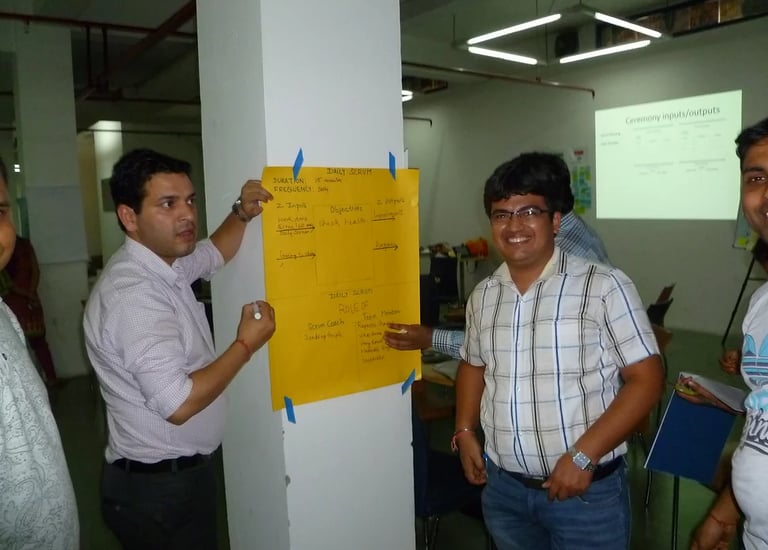


Agile Team Alignment in SFO and India
Communication and collaboration are critical even when teams are collocated, but when a Dot Com company in San Francisco grew to two locations a world apart from each other, they knew that they needed help in scaling the Scrum process across continents.
The challenge was in managing a shared code base and prioritizing feature enhancements without driving repeated testing or introducing code changes that affect all feature areas. The organizational design needed smaller teams and dedicated Product Owners so the developers could focus on the key value areas without Product managers competing priorities. By implementing Jira and Confluence, the remote teams could find the information they needed while US teams were sleeping. Communicating using Scrum ceremonies reduced the interruptions and missed messaging that can happen with remoted teams in different time zones.
Small or Large, Multiple Scrum Teams Need Standardization
Scrum teams are all unique. Yet, there is a need to provide structure that allows them to work together effectively without losing their agency and character. Leadership needs to be able to consume the data across all teams and easily see the big picture. And the more teams there are, the more of a need for tracking metrics that are meaningful to the teams and leadership.
The challenge is avoiding a "scaled" approach that is so rigid that it does not allow for the innovation and dynamic results from self-organizing teams. Yet teams must be aligned with each other and reducing impact from dependencies and hand offs. It is a fine balance that exists in large companies with many teams as well as smaller companies with 10 or less teams.
When a large biomedical company reorganized the product teams across 3 cities with one in Europe, multiple teams were struggling with aligning their working approach and personality conflicts arose. The director wanted to use an agile process that would work for all the teams and was contending with low morale from the sunsetting of products and the reorganization. The distributed teams needed autonomy and alignment. By gathering all team members into the same training program, clarifying the goals and reorganizing the roles and tools (Jira), the teams were able to better communicate and prioritize using regular quarterly planning conferences and Scrum Reviews.


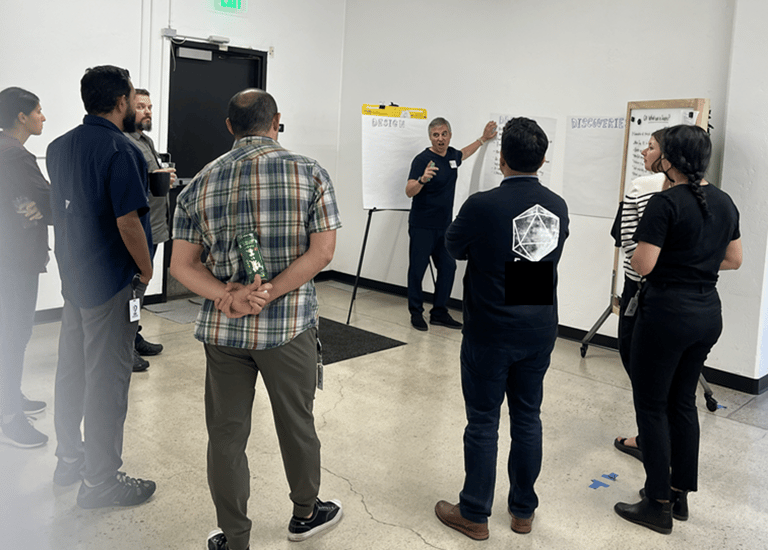
Building the Right Product Right
Two companies struggling with similar issues: a large biomedical company struggling to deliver value despite long development cycles and a small fintech company backlogging fee-for-service work in messy confusing work queues. The unintended result was the same for both: delayed delivery dates and learning that the product was not meeting the needs of the client resulting in rework.
The struggle was beyond adopting an agile process and was rooted in not taking the time to truly understand what the value proposition was for their clients. In their hurry to "scale", they were pushing too much through the pipeline with the focus on dates vs value. This is where superior product management is key.
The biomedical company enhanced their product value by training their product owners and hiring expert Product Management and UI staff. The fintech company required a reassessment of how much work they were capable of doing and focused on prioritizing unfinished work before starting new projects. By bringing on a Product Owner who was an ex-client and had extensive experience using the product, their developers were able to build the right solutions. Both companies discovered a need for better DevOps to facilitate development and reduce cycle times.


